Assessment of two wind gust injection methods: Field velocity vs. split velocity method
Abstract
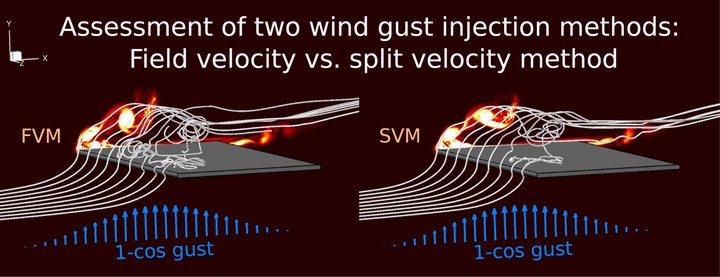
The objective of the present paper is to revisit two well-known wind gust injection methods inconsistent manner and to assess their performance based on different application cases. These are the field velocity method (FVM) and the split velocity method (SVM). For this purpose, both methods are consistently derived pointing out the link to the Arbitrary Lagrangian Eulerian formulation and the geometric conservation law. Furthermore, the differences between FVM and SVM are worked out and the advantages and disadvantages are compared. Based on a well-known test case considering a vertical gust hitting a plate and a newly developed case taking additionally a horizontal gust into account, the methods are evaluated and the deviations resulting from the disregard of the feedback effect in FVM are assessed. The results show that the deviations between the predictions by FVM and SVM are more pronounced for the horizontal gust justifying the introduction of this new test case. The main reason is that the additional source term in SVM responsible for the feedback effect of the surrounding flow on the gust itself nearly vanishes for the vertical gust, whereas it has a significant impact on the flow field and the resulting drag and lift coefficients for the horizontal gust. Furthermore, the correct formulation of the viscous stress tensor relying on the total velocity as done in case of SVM plays an important role, but is found to be negligible for the chosen Reynolds number of the present test cases.

Khaled Boulbrachene
Research Associate
CFD engineer specializing in numerical methods, scientific computing, and high-performance computing.